

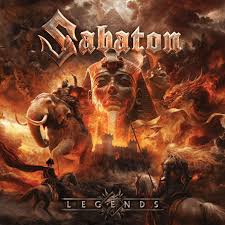
Swedish metal band Sabaton released its new concept album, Legends, on Oct 13. It’s a collection of 11 songs that draw on historical figures ranging from Julius Caesar to Joan of Arc. The record continues the group’s long-running focus on military history, using power-metal instrumentation to recount events and personalities that shaped civilizations across Europe, Asia and North Africa. Unlike most Sabaton albums that focus in on one particular conflict, this album stretched across all periods of history.
“Templars” centers on the medieval Knights Templar – a Christian military order established during the Crusades. The lyrics outline the group’s rise to influence, its role in protecting pilgrims in the Holy Land and its eventual suppression by European monarchies. Musically, the track uses rapid guitar lines, marching drum patterns and a choral-style chorus to evoke the scale of religious intensity associated with the order’s campaigns.
“Hordes of Khan” depicts the expansion of Genghis Khan and the Mongol Empire, highlighting the speed, scale and military coordination that defined his campaigns across Asia. The lyrics reference the mobility of Mongol horsemen and the sweeping conquests that reshaped the region’s political landscape. The track features fast percussion, rapid riffs and a steady, galloping rhythm meant to mirror the movement of cavalry, building a sense of momentum as the song follows the empire’s advance.
“A Tiger Among Dragons” focuses on Lü Bu, a renowned military general from China’s Three Kingdoms period who is often portrayed in folklore as an unmatched warrior. The song references his reputation for strength, his shifting alliances and the legendary status he gained in later retellings of the era. Musically, the track incorporates heavy percussion and atmospheric big melodies meant to evoke the scale of ancient Chinese battles, with brief choral elements that underscore the mythic tone surrounding Lü Bu’s story.
“Crossing the Rubicon” recounts Julius Caesar’s decision to lead his army across the Rubicon River in 49 B.C., a move that violated Roman law and triggered a civil war that ended the Roman Republic. The lyrics highlight the moment as a political and military turning point, emphasizing its lasting symbolism as an irreversible choice. The song uses shifting tempos, tense guitar builds and a commanding vocal delivery to mirror the uncertainty and escalation surrounding Caesar’s advance into Italy.
“I, Emperor” portrays the rise and fall of Napoleon Bonaparte, drawing on imagery associated with his military campaigns and his eventual exile. The lyrics reference his leadership of the French army, the loyalty of his Old Guard and the farewell he delivered before his abdication. Musically, the track features steady, marching rhythms and a prominent melodic line that reflects the grandeur and formality often linked to Napoleon’s rule, creating a narrative focused on ambition, authority and legacy. This is my personal favorite song on the record. There are many other power metal songs about Napoleon, notably “I Will Rule the Universe,” by “Civil War,” but Sabaton’s interpretation focuses more on Napoleon’s acts than his ambitions and dreams.
“Maid of Steel” centers on Joan of Arc, the French teenager who led troops during the Hundred Years’ War and became a national symbol of faith and resistance. The lyrics reference her visions, her battlefield role and the execution that later contributed to her canonization. The song uses fast-paced guitar work, sharp percussion and a soaring chorus to reflect the urgency and conviction associated with her campaigns, framing her story through a blend of military imagery and spiritual resolve.
“Impaler” examines the life of Vlad III of Wallachia, the 15th-century ruler whose brutal methods of punishment earned him the title Vlad the Impaler and later inspired elements of the Dracula legend by Bram Stoker. The lyrics outline his conflicts with the Ottoman Empire, his use of impalement as a tactic of intimidation and the fear his campaigns generated across Eastern Europe. The song places particular emphasis on the political instability of the region and Vlad’s efforts to maintain control through uncompromising violence. Musically, “Impaler” incorporates a darker tone than many tracks on the album, using slow, foreboding guitar sequences, low choral accents and atmospheric synth layers to evoke the psychological weight of Vlad’s rule. The arrangement builds toward a heavy midsection that mirrors the tension and brutality described in the narrative, creating a soundscape anchored in themes of power, terror and retribution.
“Lightning at the Gates” focuses on Carthaginian general Hannibal Barca and his campaign to cross the Alps during the Second Punic War. The song references his rapid maneuvers and strategic use of terrain, while its driving percussion and steady, marching rhythm are structured to reflect the movement of his army through hostile mountain passes.
“The Duelist” centers on the ritualized combat culture of early modern Europe, following two rivals who settle their feud with steel rather than courts. The lyrics frame the duel as both a personal reckoning and a matter of honor, underscoring the fatal tension of choosing the sword over diplomacy. Musically, the track leans into sharp, quick-strike guitar lines that mimic the precision of fencing, supported by a brisk tempo and tightly punctuated drums that elevate the sense of imminent clash. The chorus broadens into an anthemic swell, echoing the dramatic finality of a decisive strike.
“The Cycle of Songs” reflects on how war stories are preserved, retold and reshaped across generations. The lyrics frame history as a repeating chorus, carried by those who witnessed it and those who inherit it. Musically, the track uses steady, rolling rhythms and a rising melodic line to mirror the idea of stories continually resurfacing.
“Till Segar” draws on the tradition of heroic mythmaking, portraying a lone warrior whose deeds are preserved through oral legend rather than written record. The song emphasizes how figures like him—half history, half folklore—become symbols of endurance for the cultures that remember them. Musically, the track leans into a strong mid-tempo march, with driving drums and a repeating guitar motif that evokes the steady rhythm of a long journey. The chorus opens up into a melodic, chant-like refrain, reinforcing the idea of a tale carried forward by many voices over time.
“Legends” marks a deliberate shift for Sabaton, trading the specificity of modern wartime narratives for a broader sweep of myth, empire and historical memory. By spanning centuries and cultures, the album presents conflict as a universal human constant rather than a moment fixed in time. Its storytelling focus, paired with the band’s familiar power-metal intensity, reinforces Sabaton’s role as one of the genre’s most recognizable historians in song.