
At Jonathan Alder, there are a variety of mental health resources that the student body has access to, but they sometimes go unnoticed or unused.
In our district, we have two elementary school buildings, a middle school, a junior high, and a high school. All together, the district serves over 2,000 students, but according to student support specialist Sarah Wiechman, she has only seen around 60 kids throughout the school year.
Wiechman, however, isn’t the only person students can go to. We also have guidance counselors that are always available for school reasons and mental health reasons, and those visits aren’t always routed through Wiechman.
“Depending on what kind of mental health services they would need,” Weichman says, “[students in need] would either be connected with our school counselors that we have in each building, or I would have them meet on a more regular basis, because sometimes our school counselors can’t always meet one on one on a regular basis. We have a mental health specialist here who will meet more regularly with students, but if they need something that’s a little bit more intensive, like counseling wise, I will generally refer them out to a counseling agency outside of school.”
Senior Estrella Flores-Villanueva says, “I’ve met a few people who have good relationships with the [guidance] counselors. In general, I know that counselors are available if we need them for anything outside of academics, but I think that was a bigger thing in elementary and middle school. In high school, we know them more for academics.”
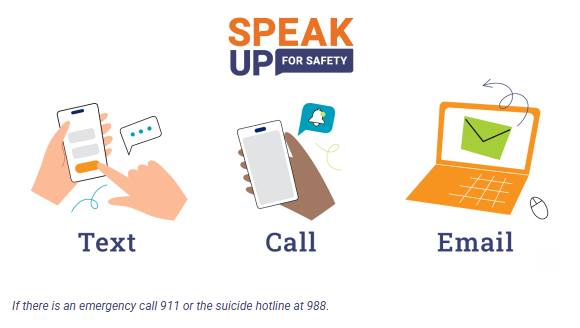
Another resource students at Jonathan Alder have is a monthly SpeakUp email. Once a month, each student gets an email allowing students to speak up anonymously about anything happening at school. This is a district-wide program, and students, parents, and community members can also submit things via the district website.
According to the website, “Jonathan Alder is fully committed to curbing student bullying and school violence and providing a positive learning environment for all students. As part of our commitment, the district offers the SpeakUp for Safety Reporting System to document and respond to concerns of bullying, suicide, violence, and other safety threats.”
According to building principal Clint Hayes, information here gets submitted to the district and then routed to the appropriate principal when needed, and he often gets information in this way.
Another program at JA related to mental health is the Signs Of Suicide program.
Prior SOS supervisor and health teacher Craig Kyle says, “[The program] started back when, unfortunately, we had two students here die by suicide, and Children’s Hospital reached out to our school district to help with that.”
As of the last couple of years it has been a mandated that every school in the state of Ohio has to provide suicide prevention for students in sixth through 12th grade.
The SOS program is videos that they show us to bring more awareness of the topic of suicide. Kyle says the program helps students be able to talk about the topic.
“Once you bring something to their attention that you know someone else is dealing with,” Kyle says, “it makes it a little bit more socially acceptable for them to hear and understand that and to be more willing to talk about.”
Flores-Villanueva agrees.
“I definitely think [SOS] is necessary,” she says, “because it focuses on topics that we don’t talk about enough…it brings awareness to the topic.”
That awareness, according to Kyle, is the goal.
“If we raise awareness and get people talking about it, then I think that’s a success,” he says.
Wiechman agrees that any impact is worthwhile, and students are good at advocating for themselves and each other.
“Some students are really great about what they need and they know how to ask for help,” she says. “I think there are some students that probably don’t even know that there is help out there…there’s still a little bit of a stigma as well, so that thought of like ‘I don’t want people to think less of me because I’m asking for help.’ So we definitely have resources here that can help students, but…[the programs we have] definitely help just bringing awareness, because I feel like our students have done a really good job of looking out for each other.”